Cultural-heritage preservation rooted in music history centering around themes of oppression & crimes against humanity
Music for Human Rights
Music Beyond Borders (MBB) preserves and shares the world’s rich cultural heritage through the power of music. We create archives, books, films, musical narratives, and innovative digital projects rooted in music history that bring to light stories shaped by oppression, crimes against humanity, human rights, slavery, protest, social justice, migration, and cross‑cultural encounters from the early modern period to today.
At MBB, we believe music is more than sound and art—it is resistance, testimony, memory, survival, and community. By treating music as a living archive, we honor voices of the past that might otherwise be forgotten and empower new generations to understand, reflect, and connect across borders and histories that continue to shape our world.
At MBB, we capture the vibrant diversity of the human experience by transforming real stories into instruments that promote public awareness and incite civic engagement to defend humanitarian values.
Our Sponsors
Wits Institute for Social and Economic Research (WiSER)
Dr. Janie Cole (PhD University of London) is Assistant Professor of Musicology at the University of Connecticut and a Research Affiliate of the Council on African Studies at Yale University. She was a Research Scholar at Yale University’s Institute of Sacred Music and Visiting Professor in Yale’s Department of Music (2023-24) and is a Research Associate at Stanford University’s Center for Computer Research in Music and Acoustics (2022-). Prior to this, she was a Senior Lecturer (adjunct) at the University of Cape Town’s South African College of Music for nine years (2015-23) and Research Officer for East Africa on the University of Cape Town’s multidisciplinary Mellon-funded project Re-Centring AfroAsia (2018-23). Her specialty research areas are three-fold, focusing on music, social change and prisons in the anti-apartheid struggle in 20th-century South Africa; musical practices, instruments and thought in early modern African kingdoms (Ethiopia and Kongo) and Afro-Eurasian encounters; and music, poetry and spectacle in late Renaissance and early Baroque Italy and France. She is the author of two monographs,A Muse of Music in Early Baroque Florence: the Poetry of Michelangelo Buonarroti il Giovane (Olschki, 2007) and Music, Spectacle and Cultural Brokerage in Early Modern Italy: Michelangelo Buonarroti il Giovane, 2 vols. (Olschki, 2011), as well as numerous articles in peer-reviewed journals and book chapters. She has been granted fellowships from The Harvard University Center for Italian Renaissance Studies at Villa I Tatti (2005-6), the Newberry Library (2008), the Medici Archive Project (2002-5), won research grants from The Getty Foundation (2007-9), The Leverhulme Trust (1996-98), and The Italian Cultural Institute (1995-96), and been awarded the Stephen Arlen Award from English National Opera (1995), the Janet Levy Prize from the American Musicological Society (2010), the Author Grant Award from the Academic and Non-Fiction Authors Association of South Africa (2015), and the Claude V. Palisca Fellowship Award in Musicology from the Renaissance Society of America (2020). Janie served as Council Member of the Renaissance Society of America as Discipline Representative in Music (2015-17), was the founding Discipline Representative in Africana Studies at the Renaissance Society of America and on the Editorial Advisory Board of Renaissance Quarterly (2018-25), served on the Yale Institute of Sacred Music Fellows’ Committee (2024-25), and is co-founder and co-chair of the International Musicological Society Study Group Early African Sound Worlds (2023-). She is the founder and co-director of the award-winning Kukutana Ensemble which develops musical performances rooted in indigenous East African music and its historical links to a pre-colonial Indian Ocean World sound- and visualscapes, with Gabriel’s Odyssey (2025) nominated for a REMA Early Music in Europe 2026 Awardin the category “Creation and Repertoire: Best Extra-European Project.” She built and curated the Malibongwe Women’s Archive of women’s struggle testimonies and music from apartheid prisons (in collaboration with University of Cape Town Libraries Special Collections funded by the Schlettwein Foundation), and has co-directed the film We Are Not Afraid: Music and Resistance in Apartheid Prisons, with South African filmmaker, Shameela Seedat(to be released in 2026). Janie’s love of the African continent was ignited by a trip to Zimbabwe in the early 1990s as a volunteer to track numbers of the endangered black rhino in Hwange national park for an Earthwatch project. Her favourite pastime is swimming in the Great African kelpforest with her 3 children and husband, the architect Lorenzo Grassi.
Nancy enjoyed a career in the international petroleum industry holding senior positions with Sun Oil International and Morgan Stanley in the U.S. and London. She subsequently organized and led crisis management teams on behalf of European banks and their clients specializing in the reorganization of their core businesses. She has advised international companies and law firms on matters relating to arbitration, governance and board issues. She served on the board of directors of Transpetrol Maritime Services, and is godmother to the tanker “Affinity”. She was a consultant on Nancy Buirsky’s documentary film The Loving Story, and for many years a sponsor of The Full Frame Documentary Film Festival in Durham, NC. Currently, Nancy is working together with start-up businesses and organizations, advising on their business plans, financing, management structure and staffing. She also does probono work in the field of the arts and humanities. She lives between Florence, Italy and the United States.
Current Project in South Africa
Singing through the Pain: Music and resistance in the apartheid prisons
This universal story is about human strength, bravery and dignity in facing unimaginable hardship and repression. It is about right and wrong, and an unshakeable belief in profound social change. It is about the power of music in fighting for human rights.
Incarcerated and tortured in South Africa’s maximum security prisons and detention cells, music was key to survival…
It is said that no one truly knows a nation until one has been inside its jails. A nation should not be judged by how it treats its highest citizens, but its lowest ones – and South Africa treated its imprisoned African citizens like animals
(Nelson Mandela, Robben Island prisoner 466/64)
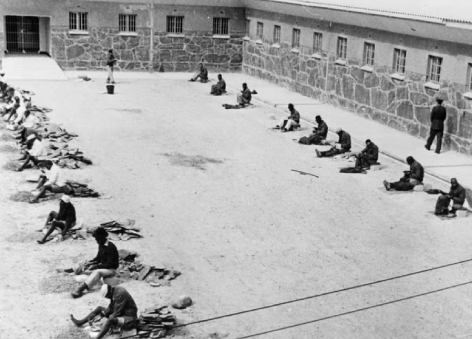
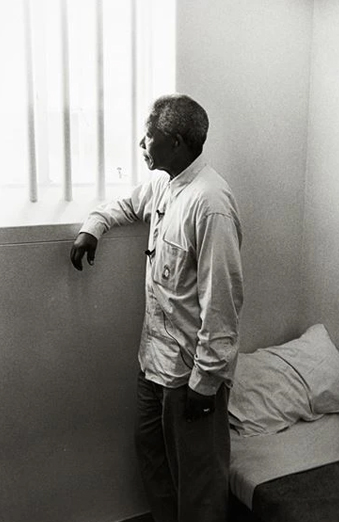
Through new interviews with surviving former political prisoners and unpublished archival documents, Singing Through the Pain examines music’s critical role in the anti-apartheid struggle, especially at Robben Island where activists led by Nelson Mandela were imprisoned and tortured during the 1960s on, and at other notorious apartheid prisons over four decades of defiance (1948-1994).
Any suffering we experienced was made more real by song and rhythm which leads to a culture of defiance, self-assertion and group pride and solidarity
(Steve Biko, tortured and died in Pretoria Central Prison)
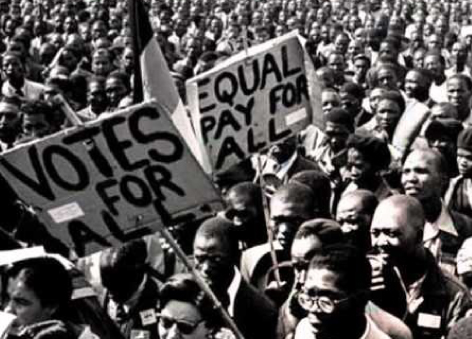
Music was a force for resistance which breeched political, tribal, language and cultural barriers. Music united courageous men and women of all races against a common enemy to express their fight for racial equality and human rights. Music provided the strength to overcome the most shocking inhuman conditions both inside and outside the apartheid prisons.
Singing is part of the cultural life of South Africans, especially black South Africans, singing is part of our very rich culture. … Every facet of our life is celebrated through music. So when you go to jail the tradition continues … When you are down, music uplifts the spirit, gives you hope. … You cannot stop a political prisoner from talking, you cannot stop an African from singing
(Lionel Davis, Robben Island prisoner 366/64)
Ironically, it is in jail that we have closest fraternization between the opponents and supporters of apartheid. … We have eaten of their food, and they ours; they have blown the same musical instruments that have been ‘soiled’ by black lips
(Ahmed Kathrada, Robben Island prisoner 468/64)
Original oral histories bring to life the experiences of hundreds of unknown foot soldiers of the struggle – black, white, ‘coloured’ (mixed race in South African race parlance) and Asian men and women from all walks of life - locked up in police cells and prisons all over the country for their part in fighting the white supremacist government’s policy of racial oppression and brutality.
It was not the searing pain that seemed to come as an explosion that took my breath away and had the greater impact, but rather the thought that fellow human beings were doing this to me in a completely cold blooded manner. The effect was dehumanizing and the anger generated was difficult to control
(Sedick Isaacs, Robben Island prisoner 883/64)
Singing with your heart [in silence], it sustains you, it composes you, because you are alone, you remember the songs that you used to sing and the songs that were sung during the times of the wars of resistance among Zulus … those songs that they used to sing when they go for war are the songs that gave me power to face the enemy when I was all alone and knew that here [in detention] they can kill me. So those songs will give you power … My body will just be a stone upon other stones to build the castle of tomorrow
(Grant Shezi, Robben Island prisoner)
These forgotten people, whose stories have until now been lost to history, gave up years of their lives for their belief that they would one day live in a free democratic South Africa. These testimonies from different political affiliations and linguistic, ethnic and tribal identities unearth a diverse range of musical repertories in their universal expression of struggle and protest.
There is an urgency to record their aging voices and their music for generations to come. The unique, poignant, vivid, heart-wrenching and uplifting musical portrait of the South African apartheid era resonates today in its universal defense of humanitarian values on a global level.
This project was launched by Janie Cole being awarded the 2010 Janet Levy Prize from the American Musicological Society. This moving story will be told via a mixed-media book, an educational film WE ARE NOT AFRAID: Music and Resistance in Apartheid Prisons, a double album of music, and a unique archive of South African oral history The Malibongwe Women’s Archive.
Travels in Sound
Launched in 2019, Music Beyond Borders’ “Travels in Sound” series consists of innovative lecture-tours in the leading traveller destinations around the world that aim to immerse travellers, music lovers, academics, and curious nomads alike with the incredible history, time and place told through the lens of music.
Join MBB on a new musical adventure in your travel destination …
Travels in Sound: South Africa
currently available:
Robben Island, Mandela and the Story of Music in the Apartheid Prisons
A unique specialized experience which offers an alternative to the standardRobben Island tourand deeply immerses thetraveler in the extraordinary struggle history of South Africa and Robben Island, a UNESCO world heritage site, and offers a new sustainable model of eco-tourism.
This private 1-hr talk hosted by Dr. Janie Cole (musicologist/adjunct senior lecturer at University of Cape Town) takes you on a musical journey of discovery, learning about the critical role music played during the anti-apartheid struggle, specifically amongst political prisoners on Robben Island. Political prisoners, the unsung heroes of the liberation movement incarcerated for daring to resist the apartheid regime, relied on music as a tool of survival, resistance, protest and communication.
Dr. Cole’s ground-breaking multimedia presentation combines original music, historical images and curated extracts from moving new interviews with former political prisoners bringing the struggle against racial oppression, conditions in the prisons, and the role of music to life in vivid relief.
This powerful introduction sets the scene for your visit to Robben Island, the most notorious apartheid maximum security prison for political activists including Nelson Mandela, who sacrificed all for their belief in democracy and human rights.
Music – from African indigenous genres like isicathamiya, maskanda, kwela, and mbaqanga to Cape jazz, traditional migrant work songs, classical, rock, reggae, and Indian ragas – provided resistance, critique, community, therapy, memory and identity for political prisoners, uniting an oppressed people against a common enemy. Night and day, political prisoners sang whatever was in their defiant hearts through torture, despair and hope, and united as one they could not be defeated. Here, communities diversified by tribal, racial and language identities turned political oppression and physical imprisonment to political advantage via the idiom of African sacred and popular song.
You will have the option of a morning/evening talk (1.5hrs), making your own way to the Nelson Mandela Gateway for the 11.00am ferry departure to Robben Island OR for a truly engaging Robben Island experience, let Dr. Cole escort you across to the island on a half day tour (4hrs) to share more of her extraordinary prison anecdotes.
Please note: the talk can be hosted in a private meeting room at your hotel (additional fees may apply, subject to hotel tariffs) and offers insight and context if one is planning to visit Robben Island. It can easily be incorporated into your day’s touring before you head off to Robben Island (ferry tickets are subject to an additional supplement). It is ideal for families, small groups or couples who are interested in gaining a more specialist view of prisoner life on the Island. For an additional Half Day supplement, Dr. Cole can also join you on the Island (provided you have booked a private guided tour of Robben Island*).
What is offered by MBB’s Robben Island lecture-tour?
Exclusive insight into an entirely different angle on the Robben Island story
The original lecture can enhance the Robben Island tour experience or be a complete stand alone event which is important – not everyone has the time to go across to the Island
This is a way to avoid over-tourism – offering an experience that doesn’t require guests to travel to the Island but they can feel the struggle story through our lecture
This kind of experience allows companies to support cultural heritage preservation and philanthropic projects in local communities, in this specific case research that is a significant contribution to South Africa’s incredible cultural heritage for posterity. Makes companies re-assess how they can give back to and support local communities through their tourism.
Model of sustainability, eco-tourism and helping reduce carbon footprint which could be applied to tourism to other cultural heritage sites
High end specialist travel agents/operators working with us:
Families: making the Robben Island tour more engaging for kids (harsh content can be adjusted accordingly).
Small groups or couples with a deep interest in history, wanting to gain a more specialist view of Robben Island, prisoner life and South African struggle history and music.
Specialised academic groups
Travels in Sound: South Africa
currently available:
Into the World of the First People: the Indigenous cape Khoekhoe, Music and Foreign Encounters
For the average tourist, the history of the Cape starts in 1652 when the first European settlers arrived with Jan van Riebeeck, who established a small colony on the Cape of Good Hope as a refreshment station for the Dutch East India Company. But what was there before?
With the Khoi … the history of known music in South Africa may be said to have begun
(Kirby, 1982)
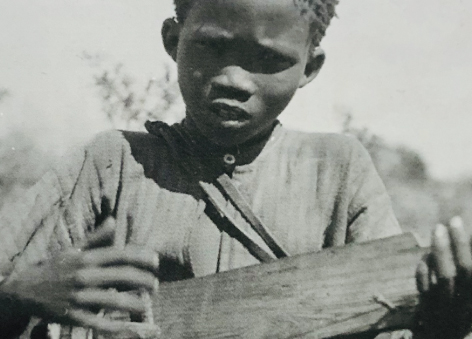
Drawing on the much lesser-known early history of the Cape before the arrival of the first Europeans in 1652, this unique specialized travel experience will take you on a journey of discovery into the world of the Cape Khoekhoe, the indigenous First People of Southern Africa, and their musical heritage in a pre-colonial Indian Ocean world.
Through a curated multi-media lecture-tour drawing on new musical sounds dug up from the Khoesan archives, descriptions from the earliest explorers, and stunning iconography, Dr. Janie Cole (musicologist/senior lecturer at University of Cape Town) reconstructs the indigenous Cape Khoekhoe communities to deeply immerse the traveler in the extraordinary early history of South Africa, its music, and the habitat of the indigenous Cape, including Robben Island now a UNESCO world heritage site—hundreds of years before its use as the notorious apartheid maximum security prison which housed Nelson Mandela.
While the history of the Cape traditionally starts with the historic arrival of the first European to round the Cape of Good Hope, the Portuguese explorer Bartolomeu Dias in 1488, startling new evidence reveals that Chinese fleets dispatched by the Ming dynasty had rounded the southern most tip of the Continent 67 years earlier in 1421, placing the pre-colonial history of the Cape and southern Africa in the context of a thriving Indian Ocean world trade network for more than three centuries.
This private 1-hr talk takes you on a musical journey to learn about essential characteristics of Cape Khoekhoe life, including their rituals, initiation ceremonies, customs, clothing, beliefs, traditional remedies, rock art, musical heritage, musical instruments, and socio-cultural practices. Who were the First People of southern Africa and what did the Cape sound like in pre-colonial times? What imaginary southern African soundscape can we envisage in these ancient indigenous rituals and musical practices?
You will have the option of a morning/evening talk (1 hr) OR combine the talk with a tour by Dr. Cole of the !Khwa ttu San Heritage Museum with staff (4 hrs) and/or Robben Island (4 hrs).
Please note: the talk can be hosted in a private meeting room at your hotel (additional fees may apply, subject to hotel tariffs) and offers insight and context if one is planning to visit the !Khwa ttu San Heritage Museum and/or Robben Island.
Testimonials
Such an amazing experience and so insightful. Thank you Dr Cole and the Khwa ttu Staff!
(Museum Visitor, 2023)
Lorem ipsum dolor sit amet, consectetur adipiscing elit. Mauris lorem lectus, dapibus in faucibus sit amet, molestie eget eros.
(Museum Visitor, 2023)
Such an amazing experience and so insightful. Thank you Dr Cole and the Khwa ttu Staff!
(Museum Visitor, 2023)
Motivation and African challenges:
MBB is documenting an essential chapter in the pre-colonial history of the Cape, its profound musical heritage, indigenous Robben Island, and indigenous knowledge systems of the first peoples of southern Africa in a bid to redress the historical marginalization of the Khoesan people and to celebrate their cultural and musical history.
The project serves to increase our awareness and knowledge of this intangible cultural heritage in southern Africa and can be used for an historical and indigenous preservation record for future generations and ethical tourism. Also research in South Africa is showing that heritage-based tourism focused on sites, music and story-telling is contributing to economic development, thereby creating employment opportunities and glue for social cohesion.
What is offered by MBB’s unique lecture-tour?
Exclusive insight into the much lesser-known pre-colonial history of South Africa, the Cape, indigenous music and communities, and an entirely different angle on the Robben Island story
An original lecture can enhance the !Khwa ttu San Heritage Museum and Robben Island tour experiences or be a complete stand alone event. This is important as not everyone has the time to visit the San museum up the West coast or go across to Robben Island
This is a way to avoid over-tourism – offering an experience that doesn’t require guests to travel to the San Museum or Robben Island but they can feel the history through the lecture
This kind of experience allows companies to support cultural heritage preservation and philanthropic projects in local communities, in this specific case research that is a significant contribution to South Africa’s incredible cultural heritage for posterity. Makes companies re-assess how they can give back to and support local communities through their tourism.
Model of sustainability, eco-tourism and helping reduce carbon footprint which could be applied to tourism to other cultural heritage sites
Types of Travelers:
Families
Small groups or couples with a deep interest in history, wanting to gain a more specialist view of the indigenous South African and Cape history, the first people, indigenous Robben Island and South African indigenous music and cultural practices.
Specialised academic groups
We Are Not Afraid:
Music and Resistance in Apartheid Prisons
A film co-directed by Janie Cole and Shameela Seedat
It is said that no one truly knows a nation until one has been inside its jails. A nation should not be judged by how it treats its highest citizens, but its lowest ones – and South Africa treated its imprisoned African citizens like animals.
(Nelson Mandela, Robben Island prisoner 466/64)
Through torture, harrowing prison conditions and abuse, music was a key to their survival.
Set against the historical context of South Africa’s anti-apartheid struggle, WE ARE NOT AFRAID explores music’s critical role as a force for resistance and survival in the apartheid prisons, especially at the maximum security prison on Robben Island, where activists including Nelson Mandela were imprisoned from the early 1960s on, and at Number 4 women’s jail at the Old Fort in Johannesburg.
Blending archival footage of major historical struggle markers such as the 1960 Sharpeville Massacre and the 1976 Soweto Uprising, extensive new interviews with former political prisoners, shot many years later after their release, and musical performance and observation, the film casts light on both past and present. Through torture, harrowing prison conditions and abuse, black music performance provided resistance, critique, community, communication, therapy, memory and identity for political prisoners, uniting an oppressed people against a common enemy. Night and day, political prisoners sang whatever was in their defiant hearts through torture, despair and hope, and united as one they could not be defeated. Women’s narratives and songs expose the deadly gender-based violence that underlay structures of state violence and express their fight against both racial and gender oppression and dehumanizing prison experiences, which differed sharply to a male-centered struggle world.
Through these remarkable resilient individuals, testimonies and music, the film touches on broader questions about cultural expression as advancing social change and the uses of music by individuals suffering and protesting the violation of human rights under oppressive patriarchal regimes at the intersections of music, resilience, power, violence, gender, race, trauma and human rights.
WE ARE NOT AFRAID is about the power of music in fighting for human rights
Unless you sing your own song, the hymn sheet will be buried away, your history will disappear, no matter how noble it is.
(Anthony Suze, Robben Island prisoner 501/63)
Motivation behind film WE ARE NOT AFRAID:
Our vision is that Music Beyond Borders’ educational film WE ARE NOT AFRAID will preserve this rich South African cultural heritage, capture the memories and meanings of sites of South Africa’s long struggle against apartheid, serve as an educational tool in local schools so that South African youth know how important it is that every person has knowledge of their past, be used at international higher education institutions both in South Africa and internationally as part of history and musicological curriculi, be screened at international film festivals, raise awareness, honour the legacy of struggle veterans, and raise consciousness, especially about gender-based violence past and present.
We believe that these struggle stories and music should be captured and told again and again, so that history does not repeat itself. Race and division are the South African apartheid story, but is also an international one #blacklivesmatter #metoomovement. If there were ever a time and responsibility to expose a shameful history and to capture this heritage before time runs out, it is now.
Before turning to filmmaking, Shameela Seedat worked in the field of human rights and social justice research and advocacy for over 15 years, including at the Constitutional Court in Johannesburg, UNIFEM in New York, and the Institute for Democracy in South Africa. Shameela’s debut feature- length documentary WHISPERING TRUTH TO POWER, about the last year in office of former Public Protector Thuli Madonsela has shown at numerous festivals around the world and won the Special Jury Award at Hot Docs International Film Festival in Canada, the Bronze Stallion prize at FESPACO, Best Documentary at Jozi FF, Best Documentary by Jury at the Luxor African Film Festival, Best Film from 2019 African Studies Association (United States) and the Images of Africa Award at the Minneapolis and St. Paul Film Festival. Shameela has also been commissioned to direct several programs for international and local televisions stations such as CGTN and SABC. Recently, she directed a series of 10 short films highlighting the work and concerns of various activists across South Africa – one of these films was shortlisted as a Top Ten Finalist for the Discovery Channel’s Don’t Stop Wondering Awards and was shown on the Discovery channel. Shameela was the 2019 Film Activist in Residence at the Tshisimani Centre for Activist Education based in Cape Town, South Africa. Her current film AFRICAN MOOT (2022) recently premièred to international acclaim at film festivals worldwide.
Tonia Moller has over 30 years’ experience in the film and television industry, starting as a sound recordist in 1984 and then moving on to production management, directing and editing. She was a semi-finalist as Director/Editor in the 2000 Vuka Awards with a PSA for the Wits Students Disability Program. In 2001 she directed the 52-minute documentary DEAD MEN DON’T TOUR about Rodriguez’s South African tour. As an editor, she is passionate about social impact documentaries. Some highlights include the documentaries I WILL NOT GO GENTLY and HOT WAX for director Andi Spitz in 2004; 7 episodes of comedy series Sorted for T.O.M.pictures in 2007, nominated for SAFTA for Best Editor – Comedy Series; The Shaman’s Apprentice with director Cathy Winter for The Healing Power of Nature series in 2007; Angels on our Shoulders, for director Andy Spitz in 2008; An Intersection for director Karen Slater in 2010; the documentary series To Hell and Back for Shoot the Breeze films in 2012; From the Same Soil for director Nicky Newman, which won the SIMA (Social Impact Media Award) for best documentary; Kenya’s Water Women for director Karen Slater, runner up in the New York Film Festival social impact documentary award in 2015; I Walk Alone for director Lauren Groenewald, Safta winner for best director for documentary short in 2016; Dance me to the end of Time with director Melanie Chait in 2021, Best Editor award at the Zurich Women in Film Festival, 2022 and Best documentary at the Cinema Systers film festival in 2022. Moller is also a musician: in 1983 she started the Afrikaans/English band Khaki Monitor with Willie Saayman. She has performed in various musicals during the late 80s, including Music Without Actors, Pump Boys and Dinettes, Hotel Polana and SA LOVE. In 1989 she was the backing vocalist for the Gereformeerde Blues Band on the Voelvry tour. She also did backing vocals for Rodriguez, Bright Blue, Robin Auld, Lionel Bastos and many others throughout the 90s as well as forming her own band, The Pressure Cookies. During the 2000s and the following decade she has continued to do shows and backing vocals, mostly as a member of Nataniels’ band.
Lindy Wilson (executive producer) worked on newspapers in South Africa and London and was director of SACHED, an independent black adult education centre in Cape Town, during the height of apartheid (1967–1979). She made her first film Crossroads (1978) about an informal settlement in Cape Town, threatened with removal, where dozens of families from rural areas had joined their working men illegally and built a viable community. By then South Africa’s forced removal policy of apartheid was in full swing, displacing tens of thousands of South Africans because of the colour of their skin. Last Supper In Hortsley Street (1983) records the removal of one of the last families of 60,000 people taken from District Six from the heart of Cape Town, whose homes were bulldozed, whose lives and livelihoods were ruined. The following year Wilson visited the banished (now renowned) doctor, Mamphela Ramphele, and made a film of the clinic she built there in defiance in a remote rural area. Robben Island Our University (1988), the first film about conditions on Robben Island made clandestinely three years before the release of Nelson Mandela, tells of how political prisoners built morale and solidarity and educated one another. With negotiations underway for a democratic South Africa, she made A Travelling Song (1993) about the country’s transition and its new story-telling potential. In 1995, she produced The Unbanned Series for the SABC: sixteen films, by independent directors which South Africans had not been allowed to see under apartheid. The Guguletu Seven (2000) is the extraordinary story of the murder of seven young men and the cover-up by police and government, which was unraveled by the investigative unit of the Truth & Reconciliation Commission. Her latest film, For Which I Am Prepared to Die (2009), is the true story of the man who master-minded the renowned ‘Great Escape’ of World War 2, her uncle Roger Bushell. See www.lindywilsonproductions.co.za.
Malibongwe Women’s Archive
Women’s Testimonies and Music from the Apartheid Prisons
Unless you sing your own song, the hymn sheet will be buried away, your history will disappear, no matter how noble it is.
(Anthony Suze, Robben Island prisoner 501/63)
The Malibongwe Women’s Archive project is building a rare collection of filmed oral testimonies, music and personal archive (photos, diaries, letters) by surviving former female political prisoners and prison guards about their experiences in the apartheid prisons and wider anti-apartheid struggle (1948-1994). This endangered body of knowledge must be preserved before these struggle veterans pass away.
The Archive will chart the active role of women against apartheid prisons and police detention cells, cases of human rights violations, and the critical role of music as resistance, survival, political expression, memory, therapy, identity and community.
The Archive will communicate a hitherto unseen female perspective on the struggle against both racial discrimination and the oppression of women. Its immense historical value lies in repositioning the place of women in the history of South Africa’s anti-apartheid struggle, which has thus far placed much emphasis on the role of male struggle heroes.
This cultural-heritage preservation project will provide a new perspective on the standard liberation struggle narrative by embracing gender issues that have been historically overlooked. It will also give a voice to former female prisoners who were failed by the Truth and Reconciliation Commission’s lack of a formal category for gender-based violence against women.
Project Outcome
The materials of the Malibongwe Women’s Archive will be made available through a fully- catalogued collection deposited at the University of Cape Town’s Special Collections to highlight the potential of the bigger Ubuntu Prison Archive project of which it forms a part (proposal available upon request). The materials will be presented with detailed metadata provided on the digital finding aid ATOM. Curated extracts of interviews, music, photos, letters and diaries, and academic essays will be showcased on an educational website using OMEKA S.
Samples from the Malibongwe Women’s Archive
“Survivors of Apartheid Prisons: The Women’s Story”
Motivation behind the Malibongwe Women’s Archive project
The Malibongwe Women’s Archive is an endangered South African archive of intangible cultural heritage which is at risk of being lost forever if the oral testimonies, music and papers of former female political prisoners of the apartheid system are not captured before they die. The collection will signal the importance and power of survivor and perpetrator testimony for creating a compelling voice for raising awareness, action, education and curriculum development, especially regarding the struggle history, music and gender-based violence.
Dr. Janie Cole (PhD University of London) is Assistant Professor of Musicology at the University of Connecticut and a Research Affiliate of the Council on African Studies at Yale University. She was a Research Scholar at Yale University’s Institute of Sacred Music and Visiting Professor in Yale’s Department of Music (2023-24) and is a Research Associate at Stanford University’s Center for Computer Research in Music and Acoustics (2022-). Prior to this, she was a Senior Lecturer (adjunct) at the University of Cape Town’s South African College of Music for nine years (2015-23) and Research Officer for East Africa on the University of Cape Town’s multidisciplinary Mellon-funded project Re-Centring AfroAsia (2018-23). Her specialty research areas are three-fold, focusing on music, social change and prisons in the anti-apartheid struggle in 20th-century South Africa; musical practices, instruments and thought in early modern African kingdoms (Ethiopia and Kongo) and Afro-Eurasian encounters; and music, poetry and spectacle in late Renaissance and early Baroque Italy and France. She is the author of two monographs,A Muse of Music in Early Baroque Florence: the Poetry of Michelangelo Buonarroti il Giovane (Olschki, 2007) and Music, Spectacle and Cultural Brokerage in Early Modern Italy: Michelangelo Buonarroti il Giovane, 2 vols. (Olschki, 2011), as well as numerous articles in peer-reviewed journals and book chapters. She has been granted fellowships from The Harvard University Center for Italian Renaissance Studies at Villa I Tatti (2005-6), the Newberry Library (2008), the Medici Archive Project (2002-5), won research grants from The Getty Foundation (2007-9), The Leverhulme Trust (1996-98), and The Italian Cultural Institute (1995-96), and been awarded the Stephen Arlen Award from English National Opera (1995), the Janet Levy Prize from the American Musicological Society (2010), the Author Grant Award from the Academic and Non-Fiction Authors Association of South Africa (2015), and the Claude V. Palisca Fellowship Award in Musicology from the Renaissance Society of America (2020). Janie served as Council Member of the Renaissance Society of America as Discipline Representative in Music (2015-17), was the founding Discipline Representative in Africana Studies at the Renaissance Society of America and on the Editorial Advisory Board of Renaissance Quarterly (2018-25), served on the Yale Institute of Sacred Music Fellows’ Committee (2024-25), and is co-founder and co-chair of the International Musicological Society Study Group Early African Sound Worlds (2023-). She is the founder and co-director of the award-winning Kukutana Ensemble which develops musical performances rooted in indigenous East African music and its historical links to a pre-colonial Indian Ocean World sound- and visualscapes, with Gabriel’s Odyssey (2025) nominated for a REMA Early Music in Europe 2026 Awardin the category “Creation and Repertoire: Best Extra-European Project.” She built and curated the Malibongwe Women’s Archive of women’s struggle testimonies and music from apartheid prisons (in collaboration with University of Cape Town Libraries Special Collections funded by the Schlettwein Foundation), and has co-directed the film We Are Not Afraid: Music and Resistance in Apartheid Prisons, with South African filmmaker, Shameela Seedat(to be released in 2026). Janie’s love of the African continent was ignited by a trip to Zimbabwe in the early 1990s as a volunteer to track numbers of the endangered black rhino in Hwange national park for an Earthwatch project. Her favourite pastime is swimming in the Great African kelpforest with her 3 children and husband, the architect Lorenzo Grassi.
joined the University of Cape Town Libraries in January 2019 as the Principal Archivist of the Special Collections Department. Prior to this, she worked as an Educator and Archivist at the Cape Town Holocaust & Genocide Centre, where she managed and coordinated the Archives Project of the South African Holocaust & Genocide Foundation between 2011 and 2018. She also coordinated and facilitated regular educational programming for museums visitors, school learners and diverse focus groups with a special emphasis on human rights education. Before moving to Cape Town in 2011, Michal worked as a Support Officer for the Struggles for Justice Programme at the South African History Archive (SAHA) in Johannesburg, where she engaged in the development of virtual exhibitions and teacher training resources related to South African history and human rights. Michal graduated Cum Laude from Wits University in 2010 with a Masters by Research in History.
holds an MA(FA) and a BA(Hons) from University of Cape Town, as well as a BA in education from University of Cologne. His research MA on South African Jazz photography drew critical reflections on Fine Arts, Social history and Music. Before his employment at UCT Libraries in 2015 as Manager of the Digital Library Services department, he worked as Digitisation Manager at the Centre for Popular Memory (UCT), as an art teacher, heading the Visual Arts Department at the German International School Cape Town, and as an archivist at the Art and Exhibition Hall of the Federal Republic of Germany. He has maintained a richly diverse freelance career, including lecturing in theory and discourse of art and critical studies at tertiary institutions in Cape Town and Stellenbosch, giving workshops in video, sound and photography, as well as writing reviews and exhibiting his photographic art. He is a Research Associate at Africa Open Institute for Music, Research and Innovation at Stellenbosch University.
Repository and Preservation: Decolonization
The Malibongwe Women’s Archive will be deposited as a mixed media archive in the Archival Film repository of the University of Cape Town’s Special Collections. Expertise in digital archiving will be provided by the Special Collections’ head Michal Singer and staff, who will advise on all aspects of cataloguing, metadata creation/management (described on Atom-Izolo) and preservation of the collection (digitally preserved in Arkivum-Izolo), together with the University of Cape Town’s Digital Library Services, headed by Niklas Zimmer. The collection will be open access. The Memorandum of Understanding with UCT serves as a key factor in demonstrating institutional support. This support is based on the centrality of the project’s alignment with the University of Cape Town’s mandate and the Libraries’ goal to contribute to the decolonization of its collections.
Funder:
Carl Schlettwein Stiftung (Basel, Switzerland)
Music Beyond Borders' collaboration with the Kukutana Ensemble
Music Beyond Borders’ activities aim to go to the heart of specific human rights issues and to publicize through its research situations of violence and repression around the world.
As books, interactive e-books and documentary films become more mainstream and accessible, the opportunity to leverage these stories into advocacy and action becomes not only more feasible, but essential to fulfilling the original intent of such projects: to inform, to educate, to move or call to action.
With our current project in South Africa, we have the opportunity to inform the public about the devastating effects of racism and the triumph of human integrity, persistence and humanitarian values.
Donate To Music Beyond Borders
Thank you for considering a donation to MUSIC BEYOND BORDERS. We appreciate your support.
All donors will be thanked in the acknowledgements pages of the relevant publications and the end-credits of films.
For more information on how to make a donation, please feel free to Contact Us.